|
Knowledge Processor
|
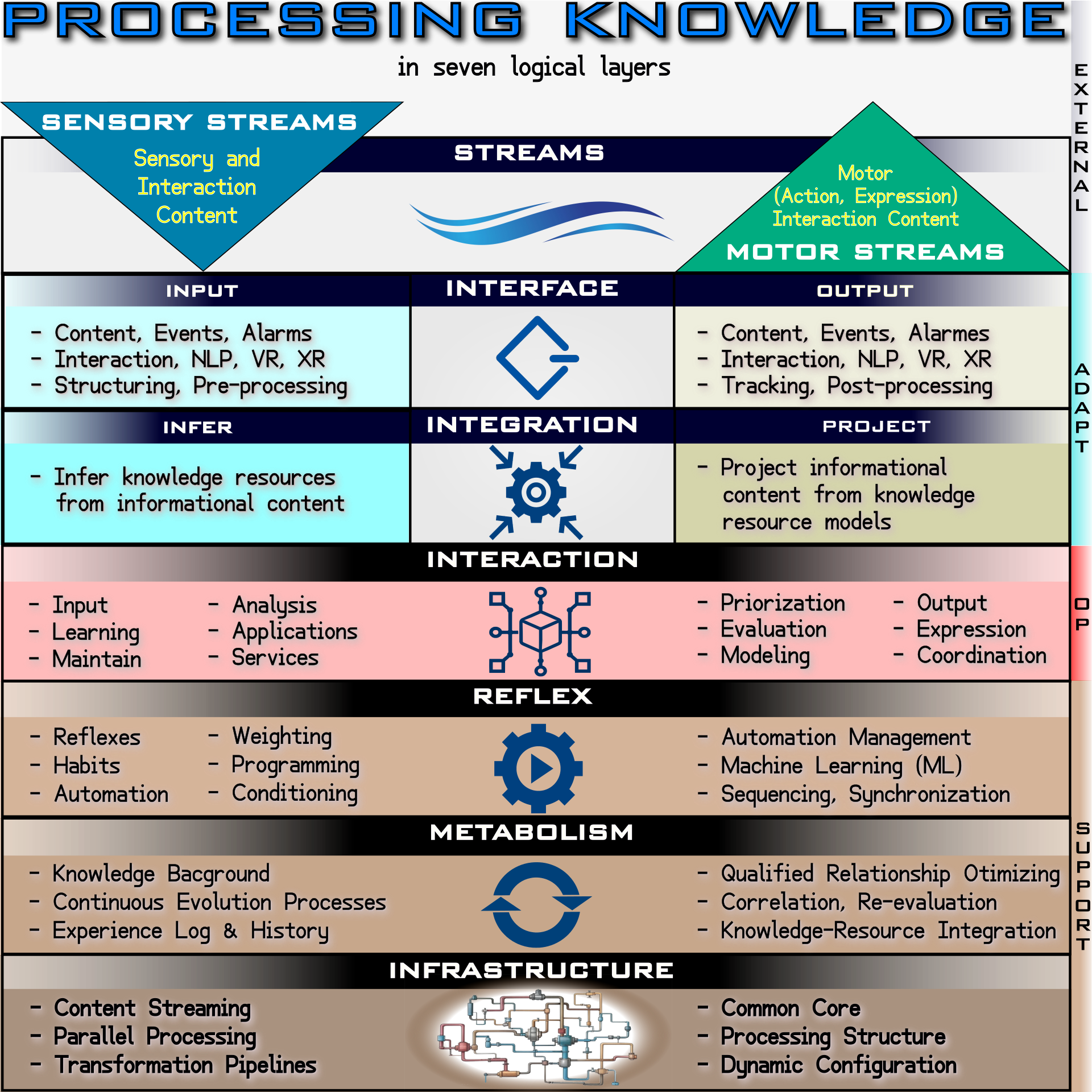
|
|
Typical Knowledge Processor Structural Diagram
|
|
Natural and artificial knowledge-processors, like humans and systems, constitute the
central resources of the knowledge processing model. They are resources that process
other resources.
To effectively process knowledge, let's say at human level, or so, Knowledge processors
require a set of basic tools that include:
- Knowledge Background
The knowledge background is the collection of all the inherited and acquired knowledge
of a knowledge processor.
- Stream Processing
Each knowledge processor needs to process its knowledge-background through its knowledge
metabolism, as well as input and output streams in its interaction with its "outside"
world or reality: the two interaction stream process types:
- Metabolic Processing
Each knowledge processor is required to constantly improve and evolve its knowledge
background through continuous internal streams and processes, analysing, evaluating,
integrating, correlating, optimizing to better evolve its knowledge.
- Sensory Input Streams
Each knowledge processor is required through various interfaces, to acquire, filter,
adapt, convert incoming information streams so that the knowledge processor can infer
corresponding knowledge resource streams, for processing and integrating into the
knowledge background, as required.
- Output Motor Streams
Each knowledge processor is required to create models from selected knowledge-background
resources, in order to project aspects of these models, selected from viewpoints or
angles, through different perspectives, through various interfaces, into information
streams, artifacts and behaviors.
- Reflex Zone
As a specialized part of its knowledge metabolim, each knowledge processor is required
to manage its reflex, habit and automation zone or platform, including design, conditioning,
triggers and integration.
|
